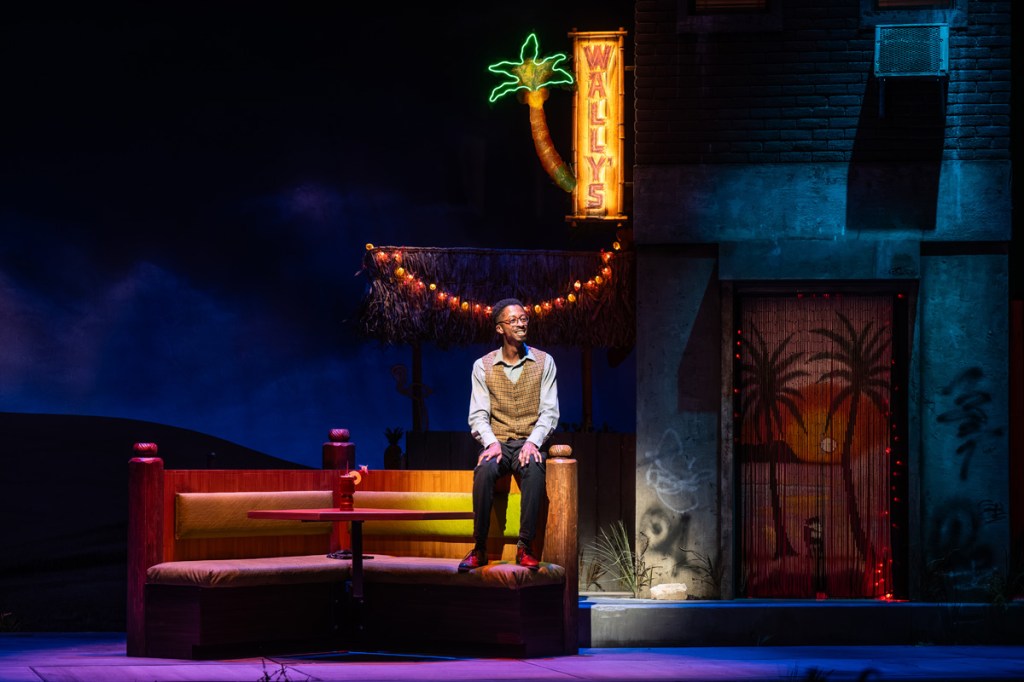
Walking into Primary Trust at Crow’s Theatre, it feels like you’re stepping onto the set of Mr. Rogers or Sesame Street – except Mr. Rogers is a high-functioning alcoholic with crippling anxiety and severe childhood trauma. It’s a beautiful day in the neighbourhood!
Primary Trust (by Eboni Booth) follows the story of a 38-year old man named Kenneth (Durae McFarlane) as he attempts to step out of his routine and improve his life. Orphaned at a young age, Kenneth has built a comfortable, predictable life for himself in the fictitious upstate town of Cranberry, New York. He goes to work at a bookshop, drinks mai tais at the local tiki bar, Wally’s, with his only friend, Bert (Peter N. Bailey), stumbles home, and does it all again the next day. When his boss (a booked-and-busy Ryan Hollyman) decides to sell the bookstore, Kenneth is forced to step out of his comfort zone and apply for a job at a bank (the titular “Primary Trust”), thanks to a chance suggestion from a new waitress at Wally’s, Corinna (Khadijah Roberts-Abdullah).
Kenneth spends a lot of time talking directly to the audience and explaining his life through monologues, which might normally irk me a bit, but McFarlane is so darn endearing that I forgave it. The whole play is underscored by upbeat, elemental background music, which, alongside the direct-address moments and the Avenue Q-esque set, adds to the “neighbourhood sitcom” vibe I mentioned earlier (live musician Danilo Reyes, sound design by Thomas Ryder Payne, set design by Julie Fox). The music and stage layout give the show an optimistic, uplifting feel, even when the subject matter gets intense.
I liked this play quite a lot. It won the 2024 Pulitzer for Drama, so the storytelling is solid. The show is heartbreaking, but not in an unbearable way. On a scale of “eyes watering a little” to “inconsolably weeping on the floor,” I’d put this at a “single tear delicately dancing down your cheek.” Booth’s script treats Kenneth with such warmth and generosity that even its most heartbreaking moments are handled gently. The play doesn’t wallow in the pain – it acknowledges loneliness, grief, and trauma without ever losing sight of hope.
And the acting is, across the board, fantastic. McFarlane makes Kenneth completely lovable – we root for his wins, mourn his losses, and remain patient with him as he missteps. Expert work. The supporting cast of Bailey, Roberts-Abdullah and Hollyman are all strong as well.
If I’m honest, I haven’t quite figured out how to critique directors yet. It’s one of those things where, if the direction is bad, you notice it immediately, but if it’s good, it either goes unnoticed or it’s unclear what should be attributed to the directors vs the actors. I’ll give it a shot and explain why I think Cherissa Richards’s direction works so well:
The play feels cohesive. All the characters feel as though they exist in the same world, if that makes sense. Hollyman and Roberts-Abdullah play a variety of characters, but none seem out of place. While all the characters are distinct from one another, no single performance overshadows the rest. There’s a tonal consistency, the pacing is great, and the stage is used effectively (i.e., there are no random divots in the middle of the stage that are interacted with once and otherwise avoided as though they’re made of lava).
And if I could harp on the set for another moment: if I can give Crow’s Theatre an award this season, it’s for the most expensive-looking sets. Walking out, I noticed cool details like old staples and ripped paper on the telephone pole. Nice touch.
The Crow’s landing page for Primary Trust describes the play as “affirming and tender” and “a poignant meditation on connection and the courage it takes to transform your life.” I love when the promo material is accurate.
Playing until June 21, 2026.
Featured Image: Durae McFarlane in Primary Trust, by Dahlia Katz

