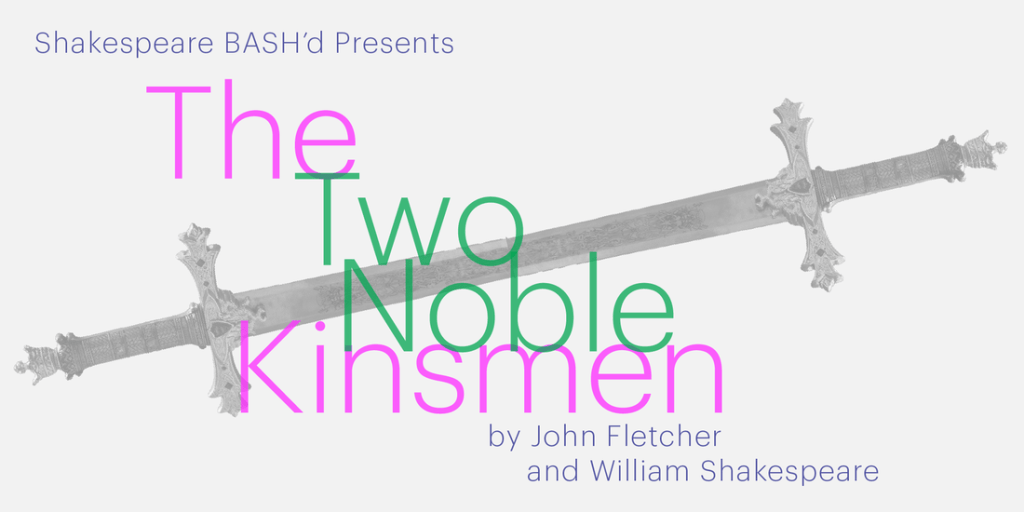
Hi there, theatre fam. Sorry I’ve been MIA for a bit – it’s been a hectic few weeks. Alas, I’m back, and with a really fun interview! I had the pleasure of speaking with Melanie (“Mel”) Leon and Jeff Yung 容海峯, two of the stars of Shakespeare BASH’d upcoming production of The Two Noble Kinsmen (Jan. 25- Feb. 4 in Toronto – ticket info at the bottom of the article).
I’m really excited for this production for a variety of reasons:
- Mel & Jeff are super cool
- My friend Emilio Vieira is in this show (#imsocool)
- The Two Noble Kinsmen is a rarely produced Shakespeare play, so that’s neat; and
- I’m intrigued by the ShakesBASH’d approach to adapting works. Unlike other adaptations of lesser-known Shakespeare plays I’ve seen in the past year (*cough* Stratford’s Richard II *cough*), ShakesBASH’d doesn’t use flashy sets or costumes, or make major changes to the text. Instead, they present the play as-is (though sometimes in unconventional venues, like a bar). They force the audience (and creative team) to think about how the play fits into our contemporary lives, instead of changing the play to make it more modern. I hope I’m summarizing that accurately, but if not, Mel and Jeff give a much more articulate description in the interview below. I hope you enjoy!


Mel Leon & Jeff Yung, photos from Shakespearebashd.com
Lori: Hi! Thanks for meeting with me today! Can you introduce yourselves and talk about your connection to Shakespeare BASHD’d?
Mel: My name is Melanie (I prefer Mel). I’m a queer artist in Toronto, and I adore Shakespeare. I went to school out west, but when I moved back to Toronto, I quit acting for like 6 years. I [eventually] came back and joined the Factory Theatre mechanicals program, and a fellow artist suggested I check out Shakespeare BASH’d because they knew I liked Shakespeare. And I was blown away by the work. Then I auditioned for them, I got a small part in their 2018 production of Measure for Measure, and I’ve been in shows consecutively ever since. That was our first show together, Jeff!
Jeff: Yeah, that was a while ago! So I’m Jeff Yung, also an actor/artist here in Toronto. Aside from acting, I’m also part of the artistic leadership collective of Shakespeare in the Ruff, another independent theatre company that does outdoor productions in Withrow Park in the summertime. I’ve had the great fortune of knowing James Wallis [Co-Founder/Co-Artistic Director and Director of Two Noble Kinsmen] for the better part of almost 2 decades, because we went to school together at TMU. BASH’d started in 2010 with a reading of Romeo and Juliet, and then they started doing shows in the Fringe. I’ve known James and Julia [Nish-Lapidus, Co-Founder/Co-Artistic Director] for a long time, James even more so, but I clearly love everything they do and everyone they bring in to the fold, so here we are again. It has been a while since I’ve done an actual production with BASH’d. I’ve done a couple of readings, but I think the last full-scale production might have been Measure for Measure.
Lori: I guess it’s a homecoming, then!
Jeff: Kind of, yeah.
Lori: Why do you think people keep coming back to perform with the company?
Mel: What keeps bringing me back, aside from enjoying James and Julia as people – is that their approach to the text is unique, in that they really respect it. They don’t put it on a pedestal, but they don’t make deep cuts or deep transitional changes to the text. It creates a bit of a puzzle for us as contemporary artists, inviting us to bring our own opinions about what the text means, and wade through these muddy waters of what a contemporary audience might think of the text. I like to do that work of what does a 500-year old play mean in today’s context, and it’s not always going to feel great, but I like the challenge, and I think a lot of us do. By doing the plays as they’re written, it does bring a certain magic to the stage.
Jeff: I agree with Mel about the approach BASH’d takes – the text really becomes the centrepiece for all the work that we do. Both James and Julia often say, “What can we do with the piece that’s already there to tell a story that makes sense and can connect with a contemporary audience?” And there is a unique challenge for both the performers and the audiences who come see the show to really dig in. I think another reason why we have a core group [of performers] is because this kind of work is so specific. It’s been a good metric not only for keeping a core group of artists, but also for finding more young artists that haven’t worked with the company before.
Lori: Can you talk about the rehearsal process?
Jeff: I think there’s a good amount of collaboration in the process. During rehearsals, James has been taking time to have discussions about what’s happening [in a particular scene], and asking if actors agree with his interpretation. It’s given me a sense of comfort and trust to go along with what’s happening, but also know that if something feels off, I can mention it.
Mel: I echo everything Jeff is saying. James and Julia are really strong artistic leaders. They know what their mandate is so clearly and the vision of what they want the show to be, and a lot of that is a focus on the words that we’re saying, and that that is interesting enough. We don’t need a big spectacle, or costumes or anything. It’s really actor-forward. And when we’re at the [rehearsal] table, when we’re mining the text for details…I find the part I bring my most self to is when we’re talking about how [the text] lands in me as Mel, with Jeff as Jeff, and which parts we can bring our contemporary opinions to. James [the Director] is really good at saying, “Ok, according to history and the text, Hippolyta is this, this and this…but what does Mel’s Hippolyta look like?” That’s something BASH’d does really well: they want you to bring you to this role, despite and sometimes contradicting what Shakespeare’s intention was. If it can serve the plot, then we bring that.
Jeff: I also think that the lesser-known-ness [of the play] does give us a bit of freedom to not be as precious about certain things, because there isn’t the same expectation as if we were doing something like Romeo and Juliet or Hamlet, for example. And I think that in combination with working with a cast that has been really supportive of each other…that’s made the process a lot of fun in addition to incredibly collaborative.
Lori: Can you tell me a bit about The Two Noble Kinsmen and why it’s important to stage it now?
Jeff: The Two Noble Kinsmen is a tragicomedy that was a collaboration between Shakespeare and his protégé at the time, John Fletcher. The play deals a lot with the idea of chivalry and upholding chivalry, which may not relate to what we as a contemporary audience would consider to be “morally sound.” The play is called The Two Noble Kinsmen, but it actually revolves around a triangle, because it’s about two cousins who fall in love with the same woman, Emilia, and how they try to solve that through chivalrous means.
Mel: There’s also a B-plot..but I think we see (with my contemporary eyes) a lot of queer themes, themes about sexuality, romantic relationships vs. friendships. What I think is different from Shakespeare’s other plays…is that the queer love story seems to be very forward, which I find very interesting, almost very contemporary.
Lori: Tell me about your characters, and your approach to your characters.
Mel: I play Hippolyta, a pretty well-known mythological figure in those times. One of James’ catchphrases throughout this process has been “this play is very Greek!”, which is so funny because it’s Greek, it’s Jacobian…it’s all sorts of things. Hippolyta has been challenging for me because she’s been written with all this context as being queen of the Amazons, but she has some moments of bleakness throughout the play where she really tells things how they are, but she doesn’t say much. Basically she’s been conquered by Theseus, those are the details we have, but the text isn’t very confrontational, she doesn’t seem super angry, and if we’re going by the text, we sort of have to assume that she’s there by choice. Which for me, as a contemporary woman, is very difficult to wrap my head around. The most I get from the play for this is the relationship between Hippolyta and Emilia – the love story between two sisters, an older sister wanting to protect her younger sister from this foreign world that they’re in.
Lori: Do you have a favourite scene, or moment in the play?
Mel: One scene in particular stands out, between Hippolyta and Emilia. It touches on that sisterly relationship of wanting to protect someone you love, but kind of knowing that they’re doomed in a way, and knowing that there’s only way through this and it’s going to be painful, and how do you both empathize and guide that person but also know that they’re headed for pain? It’s very intimate between the two of them, and I think anyone with a sister is going to feel some big feels during that scene.
Jeff: I think the other thing that James [uses] as his catchphrase is that “this play is anachronistic.” At the time that this play was written, the audience would’ve known the mythological history of Hippolyta and Theseus, but the way they’re presented in this play is out of that context to a degree. So that’s interesting. I think my character [Theseus] is the person who tries the hardest to uphold honour in the play, to a fault I would say. And is, for all intents and purposes, is the highest authority in the play. So the thing that’s been interesting for me is saying lines but not looking at actors while I’m doing it, because James is like, “you don’t need to look at them when you say that!”
Mel: You’re the king!
Jeff: [Laughing] it’s been something I’ve had to get used to. So it’s been both fun, but also challenging, because it’s not a typical thing that I do.
Lori: Do either of you have a favourite line from the play?
Jeff: One of my lines that has been stuck in my head is a line that Theseus says to the gods, ”Let us be thankful for that which is, and with you leave dispute that are above our question.” For me, what I get from that line is to try to live presently, and the things that don’t make sense…let’s leave to something that’s beyond us. I’ve been thinking about that because it’s the new year, and there’s always this pressure to be better, be greater, and I think you can often forget about where you are. It’s important to honour where you are as much as you can, particularly at the beginning of the year when there’s all this pressure from everyone else.
Mel: My favourite line in the play…Hippolyta has lots of one-liners, many of which are pretty blunt, but one that I love is, “Tis pity love should be so tyrannous,” which I think sums up the play pretty nicely.
Lori: That sounds fun to say! Shifting gears, why should people come see the show?
Mel: I think one of the biggest reasons is that you’re probably not going to see this show produced very much. So if for any other reason, you’re not going to see it very much, so now is your chance! It’s the sleeper Shakespeare that you’re not going to see very much.
Lori: Do you have a theory as to why it’s not produced very often?
Mel: I would guess that it’s probably because it’s a Shakespeare collaboration, and his involvement is debated, though I think it’s pretty obvious that it’s clearly a collaboration. But it’s not “strictly” Shakespeare, so that may have something to do with it.
Jeff: There’s lots of amazing moments in this play, there’s lots of funny moments in this play. There’s an incredible fight, there’s some dances. There’s a bit of everything in this play, so I really hope that people come and get a full experience, because there’s so many different parts to it…I’ll also say that a good reason to come see this play now is even with all the anachronistic elements of it, there is so much commentary on our contemporary society, the way things are, on a whole, still run. The way that men still dictate how things go. With Theseus trying to uphold honour, I don’t think a contemporary audience is going to side with [him] – they’re going to be on Emilia’s side. But I’m very fascinated to see how a contemporary audience reacts. [Finally], there are so many great performances happening in this play, across the board. Just come see people do some great work, and it’s going to be fun!
The Two Noble Kinsmen is playing at The Theatre Centre in downtown Toronto from Jan. 25 – Feb 4. I hope you’ll be able to join me there!
Featured image: shakespearebashd.com
 Girl Likes Theatre
4 responses to “Spotlight on: The Two Noble Kinsmen (Shakespeare BASH’d)”
Thanks for sharing Lori. I have heard of the play, but knew little about it. Great job. Have a great weekend and give my love to Jacob
Sent from my iPhone
>
LikeLike
You write so well. I would love to go to the theatre with you
<
div>
Sent from Myrna’s phone.
<
div dir=”ltr”>
<
blockquote type=”cite”>
LikeLike
<
div dir=”ltr”>Thanks Lori for revealing the richness of the local theatre world. It is gre
LikeLike
[…] a follow-up to my interview from last week, I had the pleasure of seeing the opening night performance of the Shakespeare […]
LikeLike