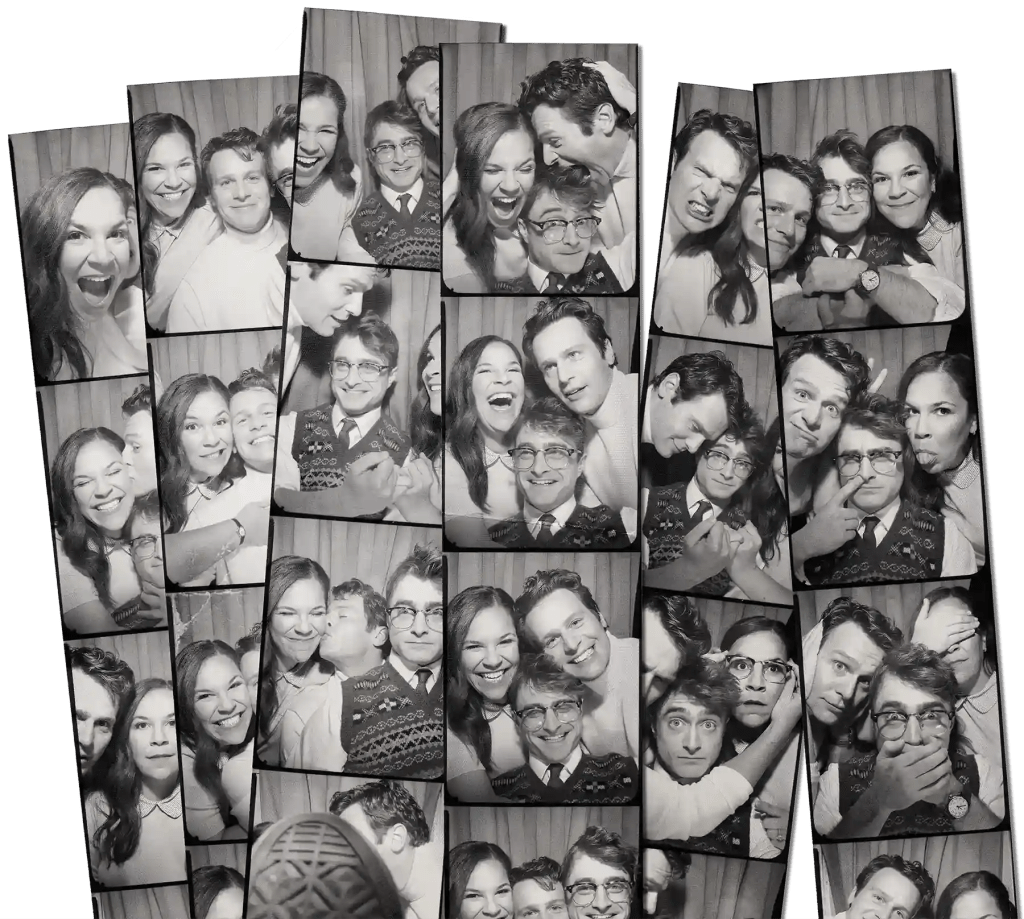
The Merrily We Roll Along Broadway revival was a full circle moment for me.
You see, I’m embarrassed to admit it, but Merrily We Roll Along is the only show I’ve ever left at intermission. Granted, I was 8 or 9 years old at the time, and I just didn’t get it. All I remember from that production is that the songs repeated themselves a lot, people wore bathrobes, and there was no dancing.
Now that I’m a full human and have experienced a lot more theatre, I thought I’d give this show another go. That, and Harry Potter is in it. (Daniel Radcliffe, not the wizard).
9 year old me was certainly no theatre expert, but I wasn’t the only one that didn’t like this show. Merrily We Roll Along is notorious for being Sondheim’s biggest Broadway flop, closing after just 16 regular performances. Just for fun, here are some snippets from reviews of the original 1981 Broadway production:
- “Merrily We Roll Along…is neither merry nor does it roll along. In fact, it clunks, lurches, and, on several occasions, faints dead away.” (Dennis Cunningham, Channel 2 News)
- “As we all should probably have learned by now, to be a Stephen Sondheim fan is to have one’s heart broken at regular intervals…Mr. Sondheim has given this evening a half-dozen songs that are crushing and beautiful – that soar and linger and hurt. But the show that contains them is a shambles.” (Frank Rich, New York Times)
- “I was never moved…I just didn’t feel for these characters. This was an ambitious gamble on a theatrical concept that just didn’t pay off in the end.” (Judy Licht, WABC-TV)
So, it surely sounds like a show that is begging to be revived, but we’ll get there. Being the intense theatre journalist I am, I did some digging to try to understand why this show was a major flop:
1. The premise was ahead of its time: Merrily We Roll Along follows the lives of three friends – Mary, Charley and Franklin – from late teens to mid-40s. The catch, though, is that the play moves backward through time, so the actors get younger as the play progresses. Many critics didn’t like this choice to begin with, but when combined with the other unconventional choices the production made (as described below), it was all just too much.
2. The casting didn’t work: The roles in the original production of Merrily were played by actors aged 16-25, “no matter what the characters’ ages or how high the toll in cuteness” (NYTimes). The idea, as described by director Hal Price, was “to have kids play themselves as embittered 40-somethings, and then you back up and see them dewey-eyed and optimistic.” The point the creative team was trying to make was that “young people know something the older folk don’t, or have lost along the way” (documentary – yes, I watched a documentary for this article). The cast wasn’t lacking in talent: Merrily was Seinfeld’s Jason Alexander’s big break, for example. However, the young casting strategy didn’t really work. Channel 2 news said that “no one [had] heft, weight or substance,” and critic Judy Licht said that the fresh-faced talent “worked against the drama” and missed “the depth, the shading, the downright agony of age.”
3. The set didn’t work: The stage was designed to look like a gymnasium, and the original opening scene was set during a high school reunion. Channel 2 called it “hideous.”
4. The costumes weren’t well received: Instead of standard costumes, actors wore sweatshirts with their characters’ names written on them. Critic Judy Licht said that the show “felt like a college production” (ouch). Channel 2 described the costumes as “marginally tacky.”
5. Unconventional development process: The original production did not follow the traditional development trajectory. Instead of an out-of-town trial, the show used its 44 preview performances on Broadway to make adjustments. And they made many changes, including recasting one of the 3 leads. During the first preview, people started walking out. I’m sure many issues were fixed during previews, but the show undoubtedly suffered from the initial negative buzz.
In contrast to the original production’s reviews, here are some snippets from reviews of the 2023 Broadway revival. It’s interesting to note that the 2023 production did not make any major changes to the source material (unlike many other regional productions of the show over the past few decades):
- “Cross your fingers: It might just be Merrily’s time.” (Adam Feldman, Time Out New York)
- “Now heartbreaking in the poignant sense only, ‘Merrily’ has been found in the dark.” (Jesse Green, New York Times)
- “The production shines a bright and welcome spotlight on a Sondheim score that has long been cherished by aficionados of his work…With this Broadway revival, sure to be the hottest ticket of the fall season, and perhaps the spring, too, Ms. Friedman and her cast and collaborators have ensured that Sondheim’s achievement will garner the wider popular appreciation it deserves.” (Charles Isherwood, Wall Street Journal)
So, why the change of heart? I think it comes down to timing, casting, and toning down some of the riskier choices.
Regarding timing: Steven Sondheim died 2 years ago, and there’s definitely been a surge in Sondheim productions since then. People want to celebrate his life, because he’s a genius. Plus, as we see in fine art, artists often become much more revered and valued post-mortem. Throw me a floaty, because I’m here for the Sondheim wave.
When it comes to casting, I’d argue that since this show is more character-driven than story-driven, it’s particularly important to nail the casting. Merrily doesn’t exactly follow a typical narrative structure – it’s more a collection of scenes depicting three friends’ lives over time. The music repeats itself quite a bit to indicate the passage of time, so it can get monotonous if performed poorly. Plus, it’s not a flashy show, so there’s nothing to distract you if the cast isn’t gripping.
The cast for this production is killer. You have Daniel Radcliffe as Charley, Broadway legend/TV star Jonathan Groff as Franklin, and Broadway powerhouse Lindsay Mendez as Mary. They’re all age-appropriate (mid-30s to early 40s), so for the majority of the show, they’re playing ages within 10 years of their actual age. By the time we get to the later scenes when the characters are in university, we’re emotionally invested enough in the story to suspend disbelief.
From a performance perspective, Daniel, Jonathan and Lindsay are perfect. They bring these characters to life, making them feel like full humans with flaws and complex emotions. The three of them together, though, is a separate kind of magic. Their chemistry is spectacular, which is likely why the production team has made a point of having the three of them do nearly every interview together. Their individual performances and their interactions with one another are truly special. I don’t know what else to say except that I wouldn’t be upset with a clean sweep at the Tony Awards.
The supporting cast is also strong. Katie Rose Clarke as Beth and Reg Rogers as Joe Josephson stood out to me, but truly everyone is wonderful. I have no notes.
Finally, regarding toning down risky choices: apart from casting age-appropriate actors, the artistic team opted for a more classic set design. The set is gorgeous, though simple in construction, and looks like an expensive, sleek LA mansion. I love how the orchestra sits in what looks like the second floor of the home. I also appreciate the choreography, which is understated and effective. Additionally, the costumes are no longer shirts with names on them, and I especially love the 70s-era party attire from the first scene. Bold patterns, Missoni zig-zags, bell-bottoms – stunning. To make a long story short: none of these elements are distracting to the plot. I could rave about every individual element of this show – I really just sat there in awe.
The bones of this show were always there. The music is gorgeous – it’s one of my favourite Sondheim scores. There are some bangers in there – “Franklin Shepard, Inc.” as performed by Daniel Radcliffe is a mic-drop moment. “Not a Day Goes By” is a real tear-jerker. And the title song, “Merrily We Roll Along,” is hauntingly beautiful. When you remove all the noise, though, I think it ultimately comes down to the casting. This show soars because of Daniel, Jonathan and Lindsay’s chemistry – and who doesn’t love watching brilliance on stage? Without the three of them, you’d still have a wonderful production, but perhaps it wouldn’t be one of my favourites of all time.
Hope you enjoyed my theatre kid deep-dive on this one. Merrily We Roll Along tickets are expensive, but I think it’s worth it. Try to see this one if you can.
Merrily We Roll Along is playing at the Hudson Theatre on Broadway until March 24, 2024, though there are rumours that it may extend to June to coincide with the Tony Awards. You could try the lottery or wake up early to get last-minute rush seats, but it’s worth the splurge (and the peace of mind) to buy tickets in advance.
Featured image: merrilyonbroadway.com
 Girl Likes Theatre
4 responses to “Review: Merrily We Roll Along (Broadway)”
Thanks Lori. Great job!
Sent from my iPhone
>
LikeLike
Thanks, Lori. I am Marnie, Ashley’s friend, and I have been silently enjoying your posts, even though I am not likely to see much theater in Toronto.
I was wondering whether spending $300 for a ticket is worth it to see Merrily We Roll Along. It sounds like it is.
I appreciate your thorough reviews and your sunny outlook.
Keep posting!
– M.
LikeLike
Hi Marnie,
Thanks for the nice comment! This one is definitely worth seeing.
I’ve got a bunch more broadway/off-broadway reviews coming over the next couple of weeks, so I hope they’ll be relevant 😊
LikeLike
Looking forward to it!
LikeLike