Hi Everyone.
Earlier this week, I saw Branden Jacobs-Jenkins‘ play Appropriate at the Coal Mine Theatre in Toronto, directed by Ted Dykstra. Another production of this play (starring Sarah Paulson) is coming to Broadway in November, so hopefully this review will be useful for my American readers, as well.
Before I dive into the play itself, I’d like to highlight Coal Mine Theatre for a moment. Coal Mine is a fairly new theatre company in Toronto, founded in 2015 by Canadian playwright/actor/director Ted Dykstra and Canadian actress Diana Bentley. The company recently rebuilt their space after a devastating fire, but they’re back and better than ever. Coal Mine’s new theatre on the Danforth is intimate but very professional-feeling, and both the production quality and talent level are very high. The set was absolutely gorgeous – so intricate and precise that it arguably became a character of its own. This was my first full-length Coal Mine show, and I will definitely be back for more. I’d highly recommend checking them out if you find yourself in Toronto.
Anyway, on to the play itself. This is a thinker.
To start with the basic premise of Appropriate: the patriarch of a white Southern splintered family has died, so the three adult children – Toni, Bo and Frank (“Franz,” as he is now called) – and their respective families, gather at the family’s Arkansas plantation to divvy up assets and sell the property. Chaos ensues.
This isn’t an outlandish premise for a play, but there’s a lot going on. Family secrets, subverted racism (it’s a white southern family), dark pasts…I didn’t feel it was too much like I did when I saw the Doctor or the Humans (perhaps a hot take). All the individual characters’ problems tie back to the core plot, so they don’t feel distracting. I never got lost in the subplots, nor did the show feel overstuffed. Nonetheless, it’s a lot, and this is a long show – nearly 3 hours with 2 intermissions. Buckle up.
I’m going to cut to the chase in an effort to remain spoiler-free – I liked the play. I thought the writing was smart, I thought there were some really great dramatic beats, and I thought there was a lot of neat symbolism (e.g. the cicadas). For me, this wasn’t a play that I came out of feeling that “I GOT IT!” – it was tricky, and I had to sit with it for a while. But I like when things make me think.
I also thought that the show was well-performed. I believed the family dynamics, and I wouldn’t be surprised if some of the actors were to get Dora nominations (Toronto theatre awards). Special shoutout to young performer Hannah Levinson, whom I met along with her friendly family after the show. I think Hannah is somewhat of a celebrity among the Toronto youth theatre community – she was Matilda in the Matilda national tour and was in Mirvish’s Fun Home a few years back. A very talented young actor, and someone I’m looking forward to seeing in future shows.
Now, after much thinking, this is what I got out of the play (in a numbered list, because I’m super professional). Some spoilers below, so proceed with caution:
1. People are complicated – a doting father to some, neglectful to others; kind and respected in some circles, deeply racist in others. It’s okay to love someone who is flawed (after all, everyone is flawed), but we should acknowledge their missteps instead of pushing them aside, even if it’s difficult to accept. Daughter Toni (Raquel Duffy) spends most of the play defending her father as non-racist, even as the evidence starts to pile up against him – an album of disturbing photos of lynched black people, a KKK mask, creepy jars of preserved body parts, various anecdotes. Toni’s brother Bo (Gray Powell) is married to a Jewish woman named Rachel (Amy Lee), and initially he admits that he thinks his father had racist tendencies. However, when he’s confronted with the KKK mask, he too makes excuses, commenting that his father “wasn’t social enough” to be in the KKK. At the end of the show, Bo breaks down crying and tells his wife that he doesn’t want his children to see him cry. It seems that Bo is more interested in keeping up appearances and hiding this darkness from his children than addressing it, further perpetuating the cycle of subconscious denial.
2. We are not our past, unless we choose to be. We can’t help where we come from. There’s a line in the show where one of the characters says “I can’t help being born a white man,” which is true. Toni refuses to believe her father is racist, let alone she herself. Yet her son Rhys (Mackenzie Wojcik) calls his aunt Rachel a “Jewish bitch,” and Toni herself (though egged on) uses the K-word against Rachel. Clearly, there are some underlying prejudices not being addressed.
There’s also something to be said about the family’s response to the disturbing photo album, which is to destroy the evidence, until they discover that it could be worth a lot of money, and then they try to sell it. Even Franz’ (Andy Tritardt) fiancé – hippy dippy, heal the world River (Alison Beckwith) – is intrigued by the prospect of financial gain. (As an aside, River is mistaken for Native American based on the way she dresses, so even if her heart is in the right place, she, too, is somewhat of a hypocrite). No one is above the greed. Who do they think they’re selling the memorabilia to? Just like Nazi artifacts, the items should probably go to a historical society or museum that will not fetishize them. Profiting off of your dad’s racism is icky.
3. The play gets into the age-old nature vs. nurture argument, and it also makes us think about people’s innate ability to change. Franz has pedophilic tendencies and struggles with substance abuse – how much of that is the result of childhood trauma and neglect? However, Franz is off drugs, resisting his urges, and he has seemingly come to reconcile with his estranged family. Franz has this messed up but well-intentioned moment with his nephew Rhys when he (mistakenly) thinks he witnesses a pattern repeating itself. Yet his fiance, River, is much younger than he is, and he withholds the full truth about his pedophilic history from her. So I think we’re supposed to question how much he’s really learned. Can we ever truly escape our past?
Now, I really liked this play, don’t get me wrong, but I have some thoughts:
1. By the start of the third act, the house has been tidied up by Rachel and River for the estate sale, and a confederate flag has been delicately placed in the corner of the room. The flag is not interacted with or acknowledged at all. I found it hard to believe that a grown woman that grew up in New York in present day (Rachel) would not understand the significance of the confederate flag, nor be made uncomfortable by it, but I guess that’s the very point the play is trying to make – the tacit acceptance of racism that exists in the family.
2. It was interesting to me that the playwright thought it was fine to say the entire k-word on stage (the anti-Semitic slur), yet the equivalent anti-black slur is referred to as the euphemism. Is the playwright making a statement as to how society knows better than to say one slur but not the other – pointing out how anti-Semitism is treated differently? Or is the playwright himself treating two forms of racism differently? That fact in itself isn’t a criticism, nor did it bother me that they used the k-word, as it was not meant to be accepted as ok by the audience (context matters)..just a thought I had.
3. I’m not sure how I feel about the play’s climax, which is a full on physical altercation between nearly all of the family members. On one level, it’s absurdist in a way that feels clownish. On another level, it further reinforces the idea that this family has some darkness hidden within, waiting to burst out. I’m curious what other people thought.
4. I really liked the tonal shift from Act 1 to 2 to 3. Act 1 was organized chaos. Act 2 was still, quiet, and a bit creepy. Act 3 built up to an outburst. It felt well-paced.
So again, I really liked Appropriate. I thought it was powerful, well-performed, and well-produced. It’s a heavy one, though, and I would love to talk about it with people who’ve seen it. So please go see it so we can chat!
Appropriate is playing at the Coal Mine Theatre in the Danforth until October 21, 2023. You can purchase tickets here.
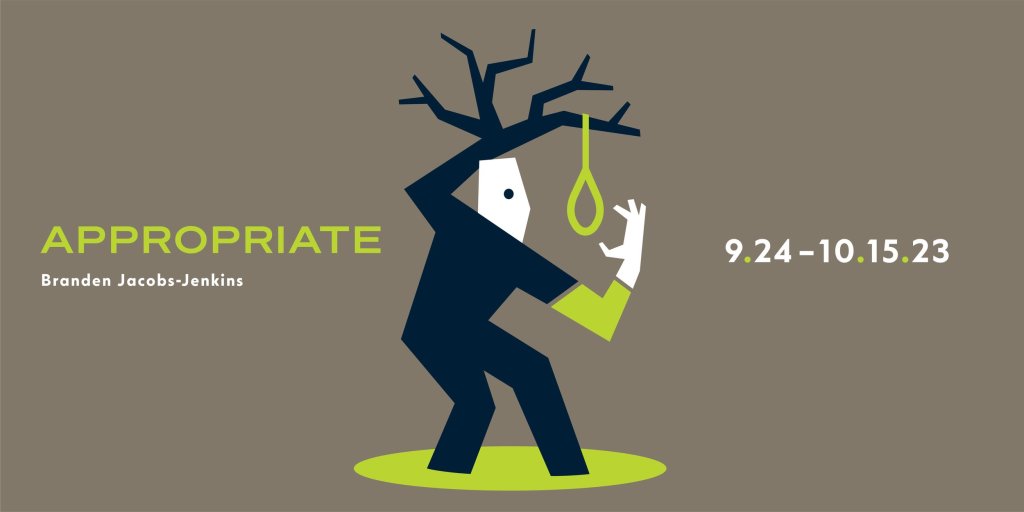
Cover photo: coalminetheatre.com. Artwork by Kostis Petridis.
 Girl Likes Theatre
4 responses to “Review: Appropriate @ Coal Mine (Toronto)”
I saw it many years ago so I don’t remember all the details but I agree with all your comments. I thought it was very powerful and I’m glad it is playing again.
LikeLiked by 1 person
Very interesting review. Never feel the need to be bashful/apologetic about an internet-friendly numbered list!
Regarding your comments on the Confederate flag, you’re astute to point out that nobody (at least of the main cast, more on that in a minute) seems to notice it, let alone refer to it directly. The reason for that is because there is no mention of such a flag among the stage directions in the original text, making it a specific set choice that appears to be unique to this production. (I’ve been reading up about past productions to see if any of them have included it as well, but have yet to find any definitive answers. Will be curious to see what the Second Stage production does!) In any case, without it being inherent to the script, it retroactively makes sense why nobody has any lines about it. With the decision to include it here, I suppose it does seem like a bit of a missed opportunity to have none of the characters react to seeing it, at least with legible facial reactions. Indeed, Rachael does seem like the most obvious candidate for such a response. However, since she and River were the ones who tidied the space between Acts 2 and 3, we can perhaps assume that her reaction occurred offstage during the interval, and that she’s made peace with its presence by the top of Act 3.
And then, of course, [BIG SPOILERS] we get the man with the clipboard at the end (portrayed, uncredited, by assistant director Matthew G. Brown), who does provided the long awaited acknowledgement of this artefact. His facial expression was perfect, simultaneously communicating discomfort at seeing it AND an exasperated lack of surprise at the predictability of such a home containing such a flag. Moreover — speaking of things unspecified in the text — the racial identity of this figure is not prescribed by BJJ, so the casting decision added an additional layer of meaning to that moment of recognition.
On a completely unrelated note, I couldn’t help wondering: what did you mean by this being your “first full-length Coal Mine show”? What non-full-length piece had you seen there prior?
LikeLiked by 1 person
Hi Ryan. I see you’re a fellow reviewer (among other theatre-related jobs)! Thank you for your thoughtful reply!! Love a good theatre convo. I hope we’ll run into each other at a show soon.
I actually got a chance to chat with Ted (the director) after I saw Appropriate (and after I posted this review – long story lol), and he answered a lot of my direction-based questions. I already appreciated the show, but I gained a deeper appreciation after hearing about his approach.
Totally agree with you re: man with the clipboard at the end. I thought that was a fantastic choice, and Matthew G. Brown was awesome.
Re: “first full-length show” – I’d been to a Coal Mine fundraiser before, so I’d seen a cabaret performance of songs from past shows and from Dion coming up next year.
LikeLike
Hi Lori, thanks for this thoughtful reply to my reply! I’ve just recently stumbled upon your blog, and have been enjoying reading/reminiscing about earlier shows from this season. That’s amazing that you were able to speak to Ted about the production; I have no doubt that he had many illuminating insights to share. See you around the theatre!
LikeLiked by 1 person