
Helllllooooo theatre community,
It’s been a minute. I’ve been traveling in Greece for the past few weeks, which has been fantastic, but I’m home and ready to dive back into theatre!
While in Athens, I had the incredible opportunity to see Bellini’s opera Norma in an ancient theatre on the Acropolis. The theatre – the Odeon of Herodes Atticus – sits at the bottom of the Acropolis with the Parthenon in the backdrop, and has been used as a concert venue for nearly 2,000 years. To think that millions of people have been coming to this theatre for thousands of years and sat in your exact seats (though perhaps the ancient Greeks didn’t have padded cushions) makes you feel part of something bigger, which is a really nice feeling. To perform in that venue must feel like you’re Lizzie McGuire at the Colosseum. Very cool all around.
If you ever find yourself in Athens and there’s a show or concert going on (Elton John performed there!) it’s worth the trip, no matter who’s performing. Technical note, though: the theatre is not great for people with mobility issues, as ancient steps are steep, so keep that in mind.
Anyway, on to the show. The opera, Norma, is Bellini’s most famous work, and is forever linked to Greek soprano Maria Callas, who performed the role of Norma 92 times (that’s a lot for an opera). This production was put on to celebrate the 100th anniversary of the birth of Maria Callas. This time around, Lebanese-Canadian soprano Joyce El-Khoury took on the title role.
For my non-opera loving folks out there, I have a few things to say:
- I get it. It’s sort of a love or hate type of thing. I’ve rarely found someone that’s indifferent to opera.
- This is an Italian opera, which I would lump into an entirely different category than German-language operas. German operas can be long and intense and heavy and too much for me. Italian operas are usually shorter (i.e. not 5 hours long), the music is flowy and romantic sounding, and, I’d venture to say, more approachable than their German counterparts. I’d say you couldn’t pay me to go to a German opera…but I totally would go if I were paid. Change my mind!
- Pro-tip: don’t think too deeply about the plot. They often don’t make the most narrative sense. I’d recommend reading a synopsis before seeing a show, because that way you can focus more on the performances than studying the subtitles.
Now on to Norma itself:
Norma tells the story of, you guessed it, a woman named Norma (Joyce El-Khoury). Norma is a Druid high priestess (funny, she doesn’t look Druish) who is in a secret relationship with Pollione (Mario Frangoulis), which is controversial because Pollione is Roman, and we hate Romans in this play. Also, I’m not sure if Norma, as a priestess, is allowed to dedicate herself to anyone but god. Anyway, they have two kids, and apparently the children only live in the castle and no one has found out about them.
Pollione has been a “naughty boy” (as my grandma would say), and he’s bedded a different, younger priestess named Adalgisa (Theresa Carlomagno). The plot is basically about their love triangle.
Since there aren’t too many scenes in this opera and I find it helpful to know what’s going on before you see the show, I’m going to break down each scene in case you want to see a production one day:
Act 1 Scene 1:
An old wizard-looking guy Oroveso (Norma’s dad) and the druid people sing about how they hate the Romans. Cut to Romans Pollione and his friend Flavio, who sing about how Norma is trash and Pollione’s new girlfriend, druid priestess Adalgisa, is way better.
Back to the druids: high priestess Norma arrives donning a fabulous headdress and says that we should make peace with the Romans (convenient, since she’s dating one).
Meanwhile, Adalgisa feels bad about being in love with Pollione – not because she knows about Norma, which she doesn’t, but because Adalgisa is basically Maria from The Sound of Music. Pollione comes to woo her, and Adalgisa, without much of a struggle, abandons everything she believes in and agrees to go with him to Rome.
Act 2 Scene 2:
Norma seems to be apathetic toward her kids (a recurring theme) and sings about how she feels something is off with baby daddy Pollione. Adalgisa comes to Norma to confess that she’s in love with a Roman man, and in a great moment of women supporting women, Norma tells Adalgisa to be with her love. Up until Adalgisa says who it is, and then Norma gets pissed. Pollione comes in, and Adalgisa and Norma band together and tell him to leave. Hooray, strong female friendships!
Act 2 Scene 1:
Norma contemplates killing her kids (rude). Instead, she asks Adalgisa to take her kids to Rome and live with Pollione as a family. Adalgisa fervently refuses, calling Pollione scum. The two share a nice moment, and Adalgisa agrees to try to convince Pollione to come back to Norma and her kids.
Act 2 Scene 2:
The druids want to attack the Romans, but Norma hasn’t said they can yet, so they’re annoyed.
Act 2 Scene 3:
Adalgisa doesn’t appear in the rest of the show, which is lame, but we’re supposed to believe that she failed to convince Pollione to go back to his family and has allowed herself to be wooed again. It’s sort of unclear, but the women supporting each other stuff is dead and Adalgisa is now also, apparently, scum. Not at all being petty, Norma declares that now is the time to attack Rome.
A druid citizen then rushes in to announce that Pollione was caught getting frisky in a druid temple, but no one knows that he was with Adalgisa. Norma’s all like “I’ll kill him,” but then she gets cold feet and makes up some excuse that she has to interrogate him first to find out who he was sleeping with so that the offender can be burned on the pyre. Norma and Pollione chat, and then just when you think Norma is going to call out Adalgisa for her actions, Norma instead announces that she herself is the guilty one. Then Norma and Pollione die. The end.
See what I mean about not reading into the plot too deeply?
Anyway, the music is the star of this production. Not to go too deep into it, but it’s really beautiful. It’s soothing like one long lullaby, and the acoustics in the theatre were perfect. All the voices of the singers really traveled, even all the way to our fairly high-up seats.
That’s the thing that’s so remarkable about opera singing, in my opinion. There’s a lot of technique required to not only hit the notes, but to sustain them such that they resonate at the right frequency to carry all the way to the back of the theatre. It’s like witnessing vocal acrobatics.
On to the performances themselves: Joyce El-Khoury was fantastic as Norma. Her acting was great, her singing sounded powerful, natural and precise, and she’s Canadian, which I love. American Theresa Carlomagno as Adalgisa was also very good. I think you could tell that she was perhaps less experienced than Joyce, but regardless, she held her own, and her voice has a beautiful texture. Tenor Mario Frangoulis as Pollione was good, but his high notes were a bit pushy. It didn’t sound as effortless as the womens’ singing.
All in all: I liked Norma. It’s not one of my favourites of all time, but I thoroughly enjoyed it (especially the second act, which moves quite quickly), and the experience of seeing a show at the Acropolis was once in a lifetime. This was definitely an unforgettable night – and I mean night. The show started at 9 pm. Those Greeks do stay up late! Thank you to my in-laws for taking me.
Anyway, that’s it for today. I’m putting a couple of photos (and a video) at the bottom of this article for your enjoyment (or my self-indulgence). Shana Tova to all of you that celebrate Rosh Hashanah! I’ll be back next week.
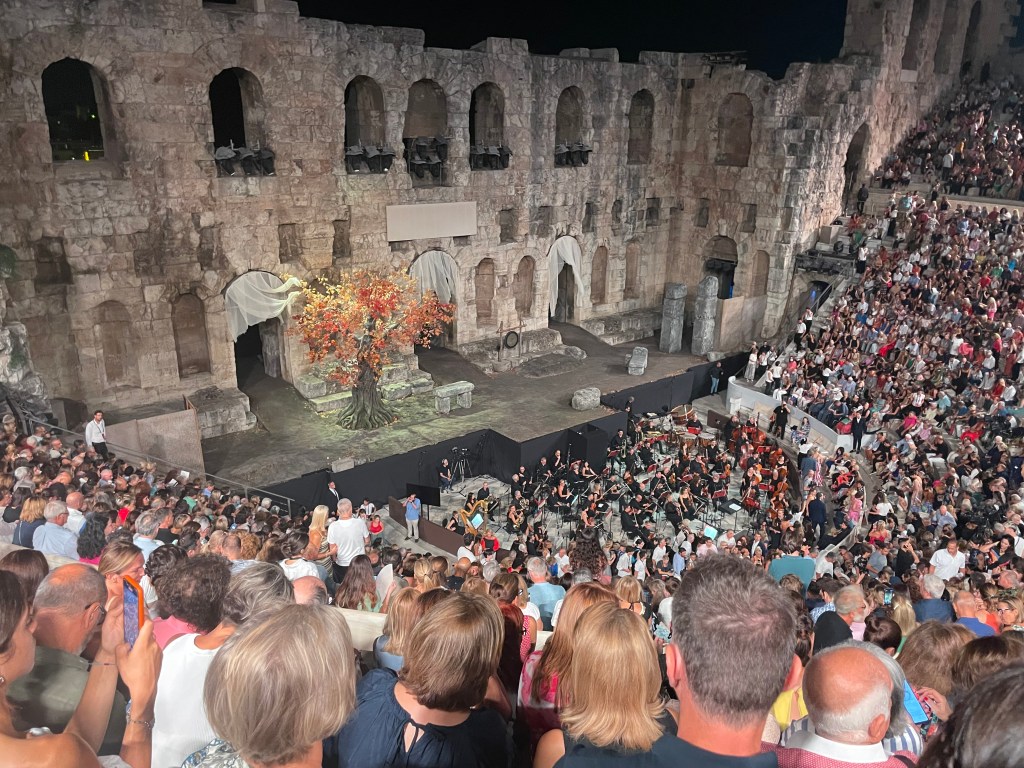
Before the show began. It was a sold out show – 5,000 people!
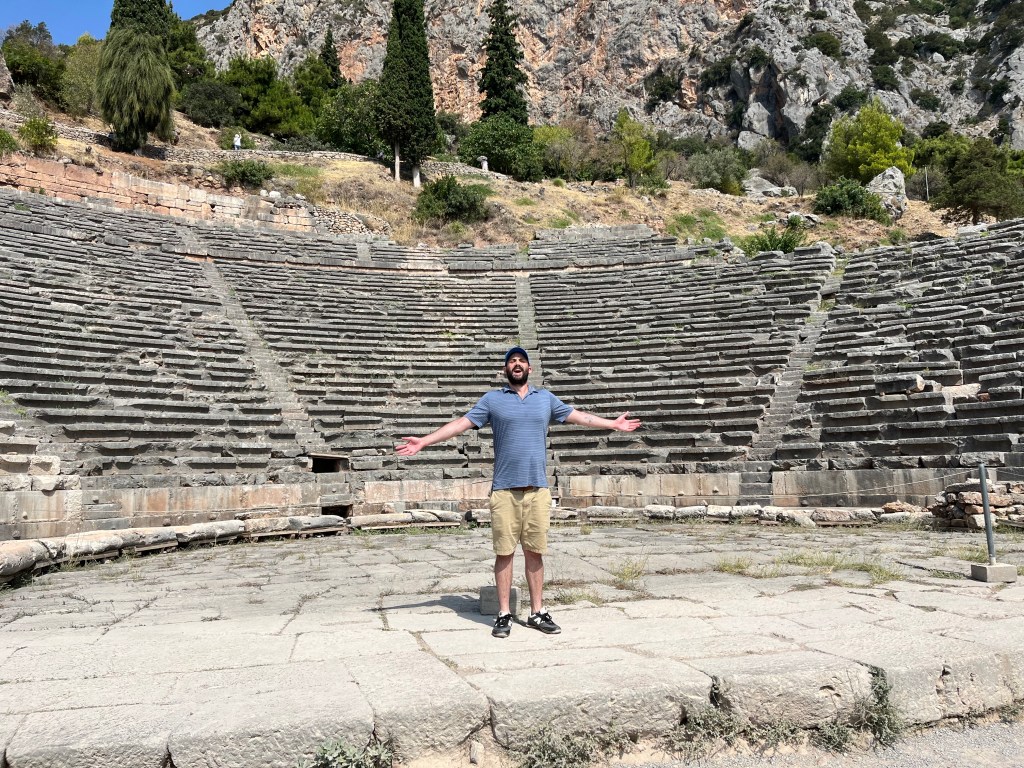
Just for fun, here’s one of Jacob (husband of the blog) at another theatre in Delphi.
To check out future events at the Odeon of Herodes, click on this link.
Photo/video credits: me and Ashley Silverman.
 Girl Likes Theatre
2 responses to “Review: Norma at the Acropolis (yes, that Acropolis)”
Great Lori. Thanks for sharing
Sent from my iPhone
>
LikeLike
A wonderful review
Love
Myrna
<
div>
Sent from Myrna’s phone.
<
div dir=”ltr”>
<
blockquote type=”cite”>
LikeLike