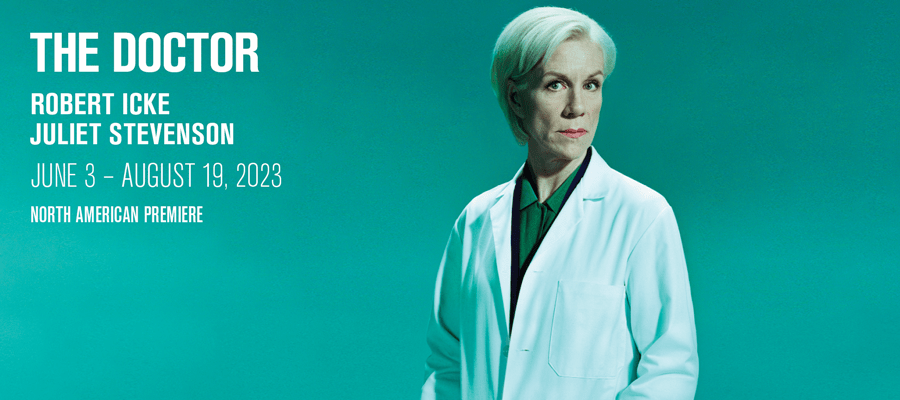
When my husband and I walked out of this show, he turned to me and said, “I don’t envy you for having to write a review on this play.” Yup…this is a tricky one.
I’m not ashamed to admit that I left Park Avenue Armory’s production of The Doctor by Robert Icke utterly confused. I had no damn idea what point the playwright was trying to make. Also, I didn’t even know if I liked the play. I hope that by writing this article, I’ll be able to figure it out.
I’ve spent a lot of time thinking about this show, but before I get into details, I’ve come to the following two conclusions:
- The lead actor, Juliet Stevenson, is brilliant. So brilliant, in fact, that it makes the material of the show come across as being better than it is. The show is inherently flawed.
- The show tries to tackle too many issues and doesn’t really come to conclusions about any of them. It’s overly ambitious.
The Doctor’s premise: a Jewish (but non-observant) female doctor – Dr. Wolff, played by Juliet Stevenson – runs an Alzheimer’s clinic, yet for some reason, she decides to admit a 14-year old patient dying from sepsis caused by an illegal, self-induced abortion. Why this girl was admitted to an Alzheimer’s ward in the first place, or who got her pregnant, I don’t know. It’s not discussed.
Anyway, so the girl is alone (offstage), unknowingly awaiting her imminent death, awake but doped up. Her parents are out of town, so they send a Catholic priest to administer the last rites. There’s nothing in the patient’s file to indicate that she herself is Catholic or would want this visitor, and there’s not enough time to call the parents. Dr. Wolff doesn’t want to cause the patient undue stress during her last moments (as the patient would realize she’s dying if she were to see the priest), so Dr. Wolff denies the priest entry. There’s a verbal altercation, and it’s heavily implied that Dr. Wolff pushes the priest. What starts as a minor issue turns into a full-on anti-Semitic witch hunt, and it builds from there. Was Dr. Wolff allowing her own anti-religious biases to impact her decision to deny the priest entry, or was she doing her duty as a doctor? And what comes first – her personal religious identity, or her role as a doctor?
At the outset, this seems like a fairly straight-forward (albeit interesting) premise. And the original play on which this one was based – Professor Bernhardi by Arthur Schnitzler – ends the story here. However, The Doctor adds some new themes on top of the previously established ones. I’ve summarized all the themes (including the original ones) below:
- Anti-Semitism
- The role of religion in medicine
- Witch hunts
- Protecting your own kind
- Teen pregnancy
- Abortion
- Unconscious biases
- Racism more broadly
- Trans/non-binary acceptance
- Teen bullying
- Alzheimer’s
- Dealing with the loss of a loved one
- Loud drumming noises (not a “theme” per say, but there was a drummer, who was great, but did they have to be so loud? I know that art is suffering, but come on. This was just silly).
It’s a lot going on. It’s too much going on, like it’s trying to broaden its appeal by throwing in everything under the sun. But Act I was ok. Act I set up the entire conflict, it asked thoughtful questions…I was looking forward to seeing how it would all be resolved in Act II. None of it was resolved. It was messy.
If you don’t want the play to be spoiled, I would stop reading here and come back when you’ve seen the show. However, if you’re in for the ride, proceed with caution…
What’s unique about this play is that, apart from the lead actor, nearly every role is played by someone who does not ethnically or gender-wise align with their assigned role. So, for example, a black woman plays a white man, a white man plays a black man, etc. etc. It’s fairly confusing to follow until the characters themselves announce something like “as a white man…” and then you can pick it up. I actually liked this choice. The main point of the show (at least, according to the program guide) is about unconscious bias. So, halfway through the play, you find out that the priest (who’s played by a white actor) is actually supposed to be a black man. So then we’re supposed to think, “Did Dr. Wolff deny the priest entry because she’s racist?”
Act II opens with Dr. Wolff being grilled on television by a panel of “experts” on various subjects (who, notably, are played by actors matching their characters’ ethnic/gender identities). They tell her she’s anti-religion, a hypocrite, a colonialist. And it’s at this point that I became utterly lost. I couldn’t figure out if the play was mocking the panelists, or Dr. Wolff. Was it anti-woke, or very woke?
The panel starts out very clearly seeming like Dr. Wolff is in the right and the panelists are absurd, but then we find out that Dr. Wolff used the word “uppity” to describe the black priest, which has racist undertones. Did she simply misspeak (as she claims), or is she, in fact, racist? One of the social justice activist panelists then tries to bait Dr. Wolff into saying the “n” word, to prove that “words matter.”
Later on, one of the other panelists delivers a monologue explaining how “woke” is an attempt to open your eyes to the changes in society, and that certainly sounded like the playwright speaking directly to the audience. So then are we supposed to be on board with banishing Dr. Wolff from society? Or are we still against cancel culture?
I’d also like to mention that the panel scene felt like it was set up to be the most important scene of the play – each point was given its own time to breathe, each character had a little moment to shine (which, for a play that’s predominantly one character and a bunch of irrelevant side voices, seemed important). The play focused more on semantics and word-policing than more serious issues it references but quickly glosses over, like why a 14-year-old girl is pregnant (was it consensual?) and violent acts of racism. Dr. Wolff’s cat was killed and swastikas were painted on her car – facts which were sort of referenced as throw-aways. It felt weird to me.
At the beginning of the show, a religious group made a petition to cancel Dr. Wolff, stating that “Catholic patients need Catholic doctors.” It started off by garnering a couple dozen signatures, but by the end of the show, it’s well into the 10s of thousands, if not more. Dr. Wolff laughed at the notion that people should have doctors of their own kind, but then by the end, since there are so many people on board, are we supposed to think, “wow, what an interesting idea?” or “wow, how insane is it that so many people are buying into this witch hunt?” When Dr. Wolff is kicked out of the medical field and contemplates suicide, did she get her just reward, or is she a victim?
The shows ends with the priest visiting Dr. Wolff at her home, after she’s lost everything. They have a polite, heartfelt conversation, and the priest admits that he doesn’t think Dr. Wolff was acting out of racism or anti-religious bias in the moment. Dr. Wolff asks the priest why he didn’t say this during her tribunal hearing, and he states that it would be betraying his religious community to do so. This scene felt like the play was trying to wrap things up in a neat bow, but all it did was make me ask more questions.
The Doctor is strawmen attacking strawmen. No one has great arguments. And I guess you could say, “well, life is complex and a clear answer doesn’t always present itself.” To which I’d reply, (1) that’s lazy writing, and (2) the program handed out has an essay explaining unconscious bias, explicitly laying out the thesis of the play. There was a disconnect between what was written in the program and what I saw on stage.
The beautiful thing about art is that some people will love this show, and all the power to them. I just wasn’t that person.
The Doctor is playing at the Park Avenue Armory (a super cool off-Broadway venue) until August 19, 2023. You can grab full-price tickets here, or check out this page for info on discount programs.
Featured image: Miles Aldridge, Armoryonpark.com
 Girl Likes Theatre
3 responses to “Review: The Doctor @ The Armory (Off-Broadway)”
My husband and I saw this play in London and I would like to personally congratulate girlwholikestheatre for walking out and for attempting to make sense of this beautifully acted but entirely confusing play!! She did forget to mention the gay character who may or may not have been real!! I spoke to a woman about my age (60s) at intermission and she was so confused and distraught by the ethnic/gender twists that she lost the plot! I found this added a layer of interest and complexity to the story that unfortunately needed to be simpler and less preachy!
LikeLike
[…] white southern family), dark pasts…I didn’t feel it was too much like I did when I saw the Doctor or the Humans (perhaps a hot take). All the individual characters’ problems tie back to the […]
LikeLike
[…] Tackling too many issues: As I did for The Doctor, here’s a list of the issues explicitly discussed in this show, separate from just holding up […]
LikeLike