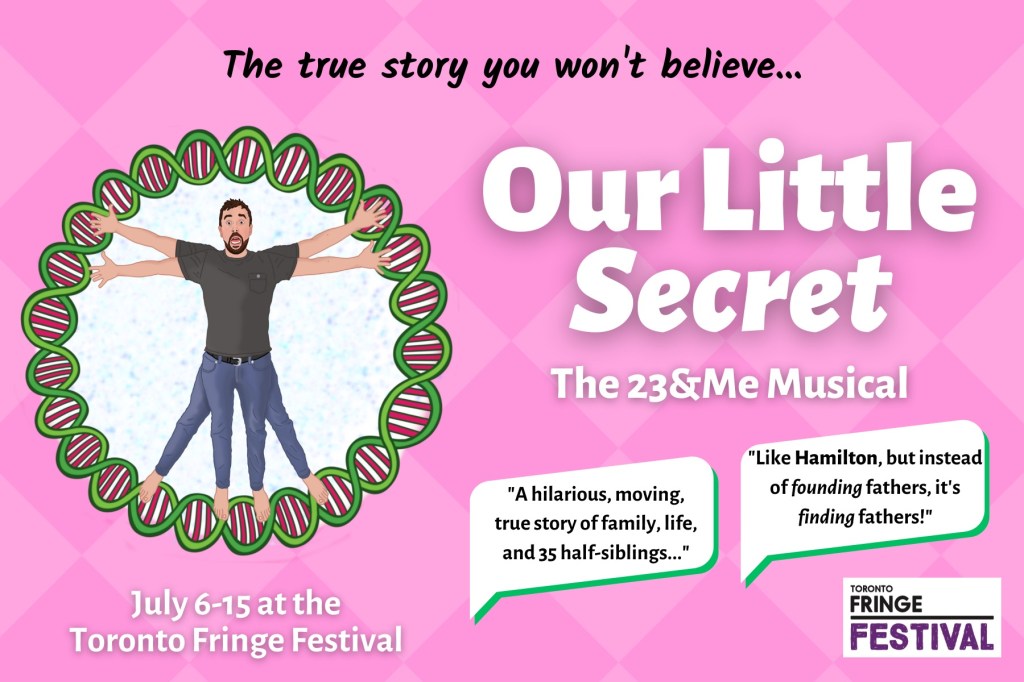
Good midday, internet (what are you supposed to say at noon? It’s barely the afternoon). Happy Fringe! To kick off this year’s festivities, I’m highlighting one of the productions – Our Little Secret: The 23andMe Musical. If you’re interested in seeing the show, I’ve been told that as of today, they’re 95% sold out…so grab your tickets fast! (Link at the end of the article).
Our Little Secret is a one-man, one-act musical that tells the story of the protagonist’s reaction to surprising DNA test results. The musical stars Noam Tomaschoff, was written by Noam alongside Ryan Peters, orchestrated by Ben Deverett, and is produced by Russell Citron – all people I know from high school. I got invited to watch a dress rehearsal and give feedback, which was really fun. I look forward to seeing how they’ll incorporate my (clearly brilliant) suggestions.
From the rehearsal I saw, I found the show delightful. Noam is a charismatic performer, the songs are pleasant and cover different styles of music, and some of the lyrics are quite clever. But I can’t even attempt to be unbiased – I’m now emotionally invested in the show – therefore I felt it best to let the creators speak for themselves.
Noam’s been doing the press circuit lately talking a lot about his personal journey (this Toronto Life article is a good summary), so I thought it’d be an interesting angle to instead focus on the creative journey. What does it take to take a show from an idea to a fully-realized production? Enjoy! 🙂
Lori: Hi, guys. Thanks for chatting with me today. Noam – tell me about your journey to writing “Our Little Secret.” Have you written before? Did you have any formal training?
Noam (writer/performer): I have no training and I’ve actually never written anything…just kidding! I went to drama school at NYU Tisch, and I didn’t plan to be a writer, although we did write [and perform] musicals in high school. After drama school and trying to be an actor for a little bit, I decided to take my fate into my own hands and write my own stuff. I started writing sketches and filming them, and I transitioned more to a full-time writing role. In 2018/19, I wrote and directed a feature film, Tankhouse, starring Christopher Lloyd and Richard Kind. I’ve since been doing more screenwriting-for-hire work, but I really wanted to get back on stage and didn’t know what the subject would be. When this story came up, well that answered itself.
Lori: What made you decide that you needed to write a show to process this information?
Noam: Before writing this show, it was just a ton of information that was really big and undefined bobbing around in my head. Writing it out to a story and sharing it with an audience helped me organize the information into the narrative of my life and my identity. Because I’ve put it all together in an order that ultimately makes sense and has an arc, it makes more sense to me personally, as well.
Lori: Why did you choose to make a musical instead of a straight play?
Noam: When you incorporate music into the narrative, you sort of get a shortcut and a power-up in terms of getting the audience to feel what it was like to experience these different moments.
Lori: Can you talk about the timeline of writing this piece and getting it accepted into the Fringe Festival?
Noam: We found out we’d received a Toronto Fringe festival slot in October [2022], but I didn’t really start writing the songs until January [2023]. Before then, I was trying to do it as a [straight] play, which I didn’t like. So January-April was the main writing process.
Lori: Tell me a bit about the writing process and working with Ryan again.
Noam: Rather than writing out a script chronologically starting with Scene 1, I put together a list of the main events in this story, such as finding out the truth, finding out the 23andMe details, meeting the half-siblings, learning who the biological father is. I took this list and decided that each event will have a song, and thus we’ll have a piece where the vast majority of the plot happens within the songs, versus in monologue. Once I had written about half of the lyrics, that’s when I came back to Toronto in April and linked up with Ryan who was on break from [his high school teaching job]. We began to complete the rest of the music and lyrics together, over 6 days of intense writing and composing.
Ryan (writer/composer): Humorously, I had just moved into my house a week prior, so there were boxes everywhere. Noam said, “is it cool if I move in for a week and take 24 hours of your day for the following 6 days?” And it was pretty intense. We were totally in the zone and in that flow state for many periods of time during that process.
Lori: What was it like collaborating with a close friend?
Noam: It was a difficult collaboration, with a lot of butting heads and big personalities. I wouldn’t do it again. JUST KIDDING! No, what was so great about it was that we’ve had 20 years to build a very effective shorthand, so the only way that we could get anything done through those 6 days was through a mutual sensibility and awareness of how things needed to be tonally. It saved a lot of time, because we didn’t really have to explain things to one another. By the end, we knew just what we wanted with a look.
Lori: How was the work divided?
Noam: Broadly I did the lyrics and Ryan did the music. But it was a collaboration – we’d discuss, “this is where we’re talking about the biological father, this is the kind of character he is, so we’re thinking it should be a jazzy number, Chicago-style.” I’d start the words, Ryan would come up with the melody, and we’d go from there.
Ryan: It was also sometimes sort of spontaneous. One of the title tracks of the show, “Brothers,” has a Celtic, Irish feel. This was written on one of our last days of writing. The night before, I threw on some “Great Big Sea,” and after two or more pints himself, Noam said, “let’s write it like this.” And the next day, I got out my guitar, and we wrote it like that. We work very well together.
Lori: And what was it like working remotely with orchestrator Ben Deverett?
Noam: I think Ben did the majority of his work in the call room at Stanford Hospital. We’d get music updates at like 4am.
Ryan: We sent Ben the keyboard tracks and asked him to add instrumentation to all of this. And he sent over a first pass, which was already like 80% of the way there. After a few rounds of feedback, we created the perfect orchestration without ever speaking out loud. Because Ben also shares that same sensibility, and, again, the shortcut was already there [from our past projects together].
Lori: Tell me a bit about the rehearsal process. Any notable pieces of advice you received from mentors/family/etc.?
Noam: When I got back to LA, I worked on the show with a director, Rose Bochner, and that’s when we devised the monologue that links all the songs together. In general, doing a solo show, you repeat it a lot, and even though it’s a true story, you can begin to sort of get tunnel-vision and barrel through it. So having people come in and provide thoughts and help restore some of the original spontaneity is very important.
Lori: Do you think you’ll add to the musical or adjust it as times goes on?
Noam: It’s almost been a year since the big reveal, and I’ve learned so much but it still doesn’t feel real. Over time, things will happen. And, of course, we want to bring it out to a 90-minute, contemporary, full-length show. So, yes, plenty more to be added, more perspectives to show. This is the kernel that things can grow out of.
Lori: What are your goals for this project? Any future runs that you have your eye on?
Noam: Our goal now is to do a really good job in these performances. The best thing we can do for the future is bring in as much of an audience as possible. And after that, we look at our options. I mean, there’s proven track records for Fringe shows going on to do more permanent runs elsewhere. There are other great festivals around the world that I’d love to go to. And also, we’ve been getting a lot of reach out from the donor-conceived communities of Canada and the U.S. who are really excited about this type of story being told on stage. So I think, you know, performing for those audiences would be the most special because they’re just like me in many ways.
Russell (producer): We’ve been getting a lot of inbound interest from…well, we’ll keep it internal for now. But there a lot of cool opportunities that we’re thinking about.
Lori: Let’s shift gears and talk about the production process. Russell, how did you get involved with the show?
Russell: Noam had told me about the [DNA] news when he found out, but I first heard about the musical in December [2022]. Since JARD (the musical we wrote in high school, “Just a Regular Day”), I always wanted to take that next step with this group. Back in January 2020, I assembled the team back in Toronto for a retreat to write a musical. We made up a plot, and it was decent, but we never moved forward with it. And then when Noam’s story happened, it was like “here we go.”
Lori: How has the production process been going?
Russell: It’s been going really well, better than expected honestly. We just passed 4 nights sold out of the show, 800 tickets sold, which is more than 80% of the full run sold out, and Fringe hasn’t even started yet. Definitely have surpassed expectations on that one, for sure.
Lori: Have you produced before?
Russell: In high school we all co-produced JARD, and I produced a charity concert at business school, but apart from that, no. I’ve started a company before (CrowdChange), and I do think of them sort of similarly – you’re taking something from 0 to 1, taking an idea and trying to get it to something that’s real, that gets traction, that people love, and gets the artist’s mission across. It’s been fun making a strategy for the show – how do we grow it? How do we build demand? How are we going to market it? Almost like a brand.
Lori: Have you had any creative input on the show?
Russell: I have. Ryan and Noam are the two major drivers on the book and music, no question. I mostly am there to give input, I’ve added a few lyrics – some they turn down, some they say yes to. I give some musical feedback…we all have a similar taste and style and coherency on what we think is good, but just as they defer to me on the business end, I defer to them on the music and lyrics end.
Noam: Russell loves a big emotional punch, and I tend to lean into the clever wordplay side of things, so it was important for Russell to come in and say, “No, this moment needs to be super emotional, you need to add this in order to be vulnerable.” And I was like, “I don’t want to be vulnerable.” But clearly you have to be, so that was a very essential addition.
Lori: What are you most looking forward to about the show?
Russell: I’m most looking forward to seeing Noam’s face at the end of opening night. This is such a personal, emotional story for Noam and he’s put so much into it. He’s had such a journey [with his career], and people say that this is the best thing he’s ever written. I’m so excited to see him take in the moment and hopefully be so proud of himself because he deserves to be.
Our Little Secret: The 23&Me Musical is running at the Alumnae Theatre in Toronto until July 15, 2023. You can purchase tickets here.
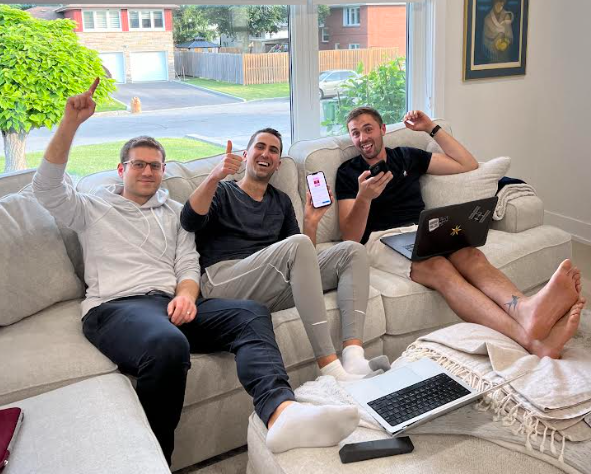
From L-R: Ryan Peters, Russell Citron & Noam Tomaschoff hard at work.
Featured image provided by the Our Little Secret production team.
 Girl Likes Theatre
One response to “The Making of a Musical: Spotlight on “Our Little Secret””
<
div dir=”ltr”>I wonder if he would want to perform his play
LikeLike