Hello internet!
We’re trying something different this time around. I’m reviewing a newly birthed musical that likely most of you haven’t seen yet, since it opened 5 days ago. (My sister had a baby last week, thus “birthing” is on my mind. Yay baby!)
Anyway, I came across this show in a roundabout way. When I went to see the Harry Potter play and saw that actress Sara Farb was out of the show, I looked her up online to see if this was a scheduled break. Turns out Sara is also a writer, and she had a new musical coming out. So, here we are. Kelly v. Kelly, produced by the Musical Stage Company and Canadian Stage.
Sara wrote the book, but the composer/lyricist of the show is Britta Johnson, who was called “Canadian Musical Theatre’s Next Great Hope” by the Toronto Star in 2017. I’ve never seen any of her work, so I had absolutely no baseline assumptions going into this.
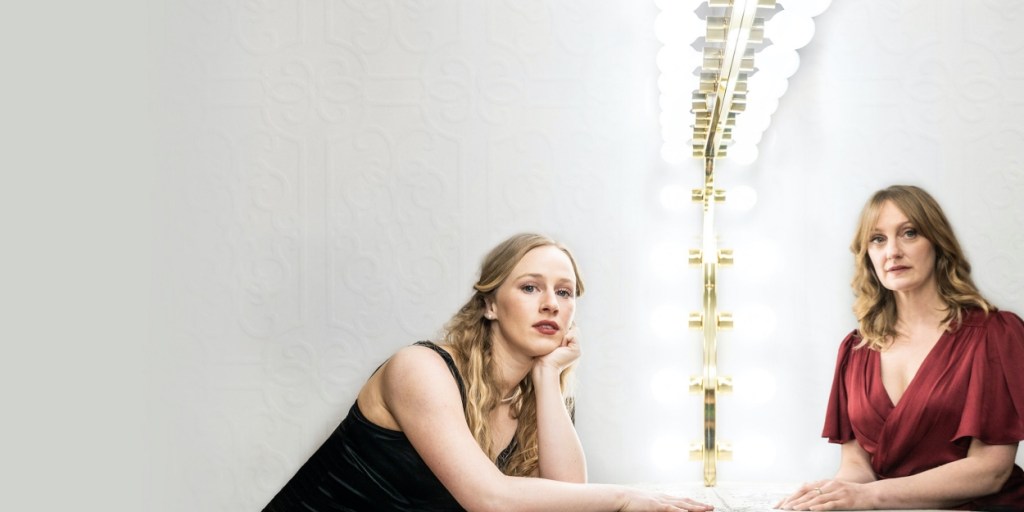
The title, Kelly v. Kelly, tells you that it’s either going to be about a trial of some sort, or perhaps a boxing match. Alas, it’s the former. Kelly v. Kelly is about a real-life trial from the early 1900s, where high-society mother Helen Kelly (Jessica Sherman) got her daughter Eugenia (Eva Foote) arrested for partying at a tango club and falling in love with a “tango pirate” named Al Davis (Jeremy Walmsley). A tango pirate, as I learned, is the Harold Hill of tango clubs – someone who charges women for dances, leads them on, and then chooses a new victim. The show delves into what it means to be a woman at the turn of the century, women’s rights, and mother-daughter relationships.
The director’s note at the beginning of the program makes the claim that this is an odd topic for a musical. Why? Trials are inherently dramatic – witnesses crying on the stand, plus, have you met a criminal lawyer? Trials are a great foundation for a play because they clearly set the boundaries and direction of the show, making it easy for audiences to follow along. Plus, mother-daughter relationships are super dramatic (love you, mom). Calling the premise “odd” implies that the show is groundbreaking in a sense, which I don’t think it is.
But, I’ll start by saying I liked it. So did my husband. I had some issues, but let me begin with some highlights before moving on to critiques:
The cast: woah. There was not a weak link in the cast of 10. Not a flat note, not a missed line. I was genuinely blown away. There were a few lead characters and an ensemble of supporting actors playing a bunch of roles each. I loved that the ensemble existed as a collective unit (serving a Greek chorus role), but also that each individual character had a distinct, clearly identifiable personality, from Margaret Thompson as a jealous frenemy, to Julia McLellan as a devoted ally.
The mother-daughter leading pair of Helen and Eugenia (Jessica Sherman and Eva Foote, respectively) was very strong. The juxtaposition between Eugenia’s light, care-free movements around the stage (and her more flowy dress) and Helen’s rigid, reserved steps (and her more structured dress – shoutout to Alex and Carmen Amini for the beautiful costumes!) was very interesting. Though shared moments between the pair were sparse (as many of the scenes existed as individual flashbacks), they played well off of each other when they were together. I believed them as mother-daughter.
It’s also worth noting that neither character was unlikeable, which is a testament to the actors and director. It would’ve been really easy to hate over-bearing, stuck-in-the-past mother Helen, but Jessica made her sympathetic.
As an aside, the actress playing Eugenia looks a lot like my theatre camp friend Meghan (she grew up with the Jonas Brothers – hi, Meghan!), and the actor playing Al Davis looks like a business school friend of mine, Rob, who used to work at Uber. So when the two did the tango, all I could think was “why is Meghan who knows the Jonas Brothers dancing with Rob who worked at Uber?” Silly Meg and Rob!
The staging/choreography: The stage was very bare – just a few seats on a raised podium, but the characters were so well-defined that it felt like a real world. I don’t love superfluous sets; I once saw a production of Hamlet with a pile of garbage barricaded on one side of the stage a la Les Mis for absolutely no reason. The choreography was also great in that it didn’t try to be a “dance show,” but it was used deliberately and sometimes as a comedic device. I especially enjoyed the moment during the song “The New Woman” when the judge (Mike Jackson) enthusiastically (and somewhat abruptly) joins in on the men’s dance.
The length: It’s a one-act, 90-minute show with no intermission. Honestly, a huge selling point.
Before I go on, I’d like to mention that it’s really hard to write a show good enough that people beyond your immediate family would want to see. So while I have some thoughts, I applaud the team for doing something I wouldn’t be able to do, and for working toward preserving and uplifting the Toronto theatre community.
The book: the show is set in the early 1900s, but the dialogue is quite modern. It sounds very fluid and natural, which helps drive home the point they’re trying to make that problems 100+ years ago still exist today. Overall, the book and music of the show felt very intertwined, and there were some funny moments, but it wasn’t overtly quippy. The book could be fleshed out a bit, I think.
The music: I’m looking for two things: (1) Does the music push the plot forward? and (2) Why are the characters singing/is it justified? Re: (1), I think yes, the music did push the plot forward. Each song (though many of them sounded similar) served a narrative purpose. Re: (2) – in musicals, in my mind, there needs to be a reason why characters have to sing certain feelings instead. Say, for instance, their emotions are so high that they can’t express them any other way. I’m not sure if the songs in this show felt justified in this way. And conversely, I think some dialogue could have been replaced with song – the testimonies, for example. The balance was slightly off for me.
The harmonies were on-point and the melodies were pretty, but ultimately I didn’t find any one song particularly memorable. I liked the use of the bass line in the jazz number, and the callback to it in a later scene. The music wasn’t offensive like some modern operas I’ve seen, but I didn’t come out humming a tune. My favourite, though, was the bass-heavy jazz number “Al’s Song” – you can check out an earlier version of the song here.
Worth mentioning: I loved the finale number. It sort of had a similar effect to the finale in Reefer Madness (deep-cut theatre nerd reference). It was tongue-in-cheek and clever but performed very earnestly, so the message of the show regarding women’s place in society really hit home.
Overall: the production was very polished, as all Musical Stage Company shows I’ve seen have been. But I was left feeling that the show is bit unfinished, which isn’t absurd considering this is its first full-scale production. I think adding more musical interludes and an overture would help create some memorable musical themes. I’m not betting on it heading to Broadway, but I liked the show and would recommend it to anyone who wants to see something other than a big, flashy production.
Pro tip, though: don’t sit in the front row of the balcony. Great views, but the legroom is terrible.
Kelly v. Kelly is playing at the Berkeley St Theatre until June 18, 2023. You can grab tickets here.
 Girl Likes Theatre